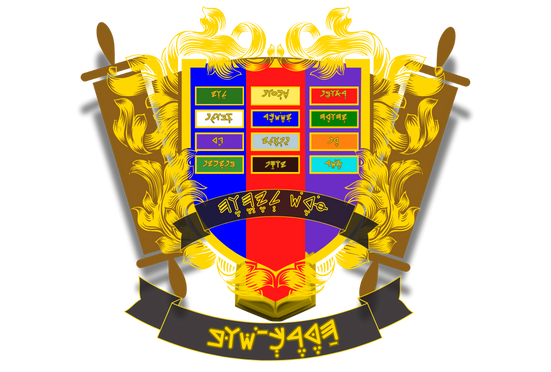
Israelite Alphabet (Yisreh'eyleeth Ehleph-Beyth): Difference between revisions
No edit summary |
No edit summary |
||
| (4 intermediate revisions by the same user not shown) | |||
| Line 1: | Line 1: | ||
<div style="float:right; width:320px; background:#f9f9f9; border:1px solid #aaa; padding:10px; font-size:90%; font-family: | <div style="float:right; width:320px; background:#f9f9f9; border:1px solid #aaa; padding:10px; font-size:90%; font-family: yisraeleet400 !important; line-height:1.5;"> | ||
<div style="text-align:center; font-size:120%; font-weight:bold; margin-bottom:8px;"> | <div style="text-align:center; font-size:120%; font-weight:bold; margin-bottom:8px;"> | ||
Israelite Alphabet<br><span dir="rtl">אָלֶף־בֵּית יִּשְׂרְאֵלִית</span> | Israelite Alphabet<br><span dir="rtl">אָלֶף־בֵּית יִּשְׂרְאֵלִית</span> | ||
| Line 25: | Line 25: | ||
Phoenician (diverged)<br> | Phoenician (diverged)<br> | ||
Moabite<br> | Moabite<br> | ||
Ancient South Arabian | Ancient South Arabian<br /> | ||
</td></tr> | </td></tr> | ||
</table> | </table> | ||
</div> | </div> | ||
== Yisreh'eyleeth Ehlef Beyth (אֶלֶף־בֵּית יִּשְׂרְאֵלִית) == | |||
The '''Yisreh'eyleeth Ehlef Beyth''' (Israelite Alphabet), also known as the '''Yisreh'eyleeth Letters''', is the original and authentic script of the people of Yisra'eyl. Unlike the modern so-called "Hebrew" alphabet—which derives from Aramaic and was later modified through post-exilic reforms and rabbinic traditions—the Yisreh'eyleeth system restores the accurate names, original pronunciations, and pictographic meanings of each letter based on early Semitic sources including Paleo-Hebrew and Proto-Sinaitic inscriptions. | |||
This restored alphabet is more than a phonetic tool—it is a sacred system of symbols reflecting the identity, covenant, and creation order of the nation of Yisra'eyl. Each letter conveys its own intrinsic meaning, shaped by ancient visual depictions and preserved linguistic truths. | |||
'''There are 22 core letter forms that produce 29 consonantal phonemes''', including voiced and unvoiced pairs that were once part of the living spoken tongue. These distinctions are preserved through the structure of this alphabet, which recognizes both the visible form and the historical phonetic value of each character. | |||
=== Why Restoration Is Needed === | |||
The commonly used "Hebrew" script is not Israelite in origin. It is Babylonian-Aramaic in form and function, created and adopted under captivity and imposed through later rabbinic influence. The result is a script divorced from the true culture, structure, and sacred meanings that once belonged to the people of Yisra'eyl. | |||
The '''Yisreh'eyleeth Ehlef Beyth''' corrects this by: | |||
The | |||
* | * Restoring the **true names** of the letters, based on early Hebrew and Proto-Sinaitic inscriptions. | ||
* | * Recovering the **true phonemes**—including gutturals, emphatics, and voiced/voiceless pairs—that reflect the actual spoken language of Yisra'eyl. | ||
* | * Reasserting the **true definitions** of each letter, derived from ancient pictographs that describe real-world objects and covenantal truths. | ||
* | * Rejecting inaccurate modernisms such as the letter "Vav" (which was always pronounced as a "Waw"), and the artificial distinctions introduced later between so-called "hard" and "soft" sounds that never existed in early Yisra'eyleeth usage. | ||
=== | === The Role of the Niqqud === | ||
<div style="overflow-x:auto;"><table class="wikitable" style="width:100%; font-family: yisraeleet400;"> | While many modern Hebrew roots movements and Israelite groups are skeptical or even dismissive of the **niqqud system** (the vowel markings), this is due to misunderstanding, not historical fact. The niqqud was a post-exilic literary aid introduced by the Masoretes—not to create new sounds, but to preserve the original vocal traditions that were already in place. | ||
* Every traditional translation, including the '''King James Version''', is based on the **Masoretic Text**, which uses the niqqud extensively. | |||
* The niqqud system allows readers to distinguish between words that look the same in unpointed text but are actually pronounced and understood differently. For example: | |||
<span lang="en" dir="ltr"><big>'''אֵל (Eyl) – God, mighty one''' | |||
'''אֶל (Ehl) – toward''' | |||
'''אַל (Al) – do not'''</big></span> | |||
* These distinctions are crucial for accurate reading, pronunciation, and restoration—especially for learners reclaiming the ancient language. Without the niqqud or mastery of the binyanim (grammatical verb structures), homographs become confusing and the original meanings become obscured. | |||
The niqqud does not override or replace the spoken tradition; rather, it encodes it and preserves it. When properly understood and used alongside the restored letter forms and names, it becomes an indispensable tool for restoring not only the writing system, but the **spoken voice of the nation of Yisra'eyl**. | |||
=== The Letters === | |||
Below is a table displaying the 29 letters of the '''Yisreh'eyleeth Ehlef Beyth'''. This includes their ancient name (with niqqud), accurate pronunciation, modern Babylonian Asuri equivalents for comparison, and definitions rooted in early Israelite meaning and usage. | |||
<div style="overflow-x:auto;"><table class="wikitable" style="width:100%; font-family: yisraeleet400 !important;"> | |||
<tr> | <tr> | ||
<th>Modern Babylonian<br><span class="ashuri">(Ashuri)</span></th> | <th>Modern Babylonian<br><span class="ashuri">(Ashuri)</span></th> | ||
<th>Authentic Israelite Letter<br>(Yisreh'eyleeth)</th> | <th>Authentic Israelite Letter<br>(Yisreh'eyleeth)</th> | ||
<th>Name (Hebrew + Niqqud)</th> | <th>Name (Yisreh'eyleeth Hebrew + Niqqud)</th> | ||
<th>Transliteration of Name</th> | <th>Transliteration of Name</th> | ||
<th>Pronunciation</th> | <th>Pronunciation</th> | ||
| Line 61: | Line 76: | ||
<tr> | <tr> | ||
<td class="ashuri">א</td><td>א</td><td> | <td class="ashuri">[[Aleph (אֶלֶף / Ehleph) – The First Letter of the Israelite Alphabet|א]]</td><td>[[Aleph (אֶלֶף / Ehleph) – The First Letter of the Israelite Alphabet|א]]</td><td>[[Aleph (אֶלֶף / Ehleph) – The First Letter of the Israelite Alphabet|אֶלֶף]]</td><td>Ehlef</td><td>Glottal stop or silent (vowel carrier)</td> | ||
<td>Ox, strength, leader – Deuteronomy 33:17</td> | <td>Ox, strength, leader – Deuteronomy 33:17</td> | ||
</tr> | </tr> | ||
| Line 192: | Line 207: | ||
Click any letter in the table above to visit its individual page. | Click any letter in the table above to visit its individual page. | ||
Latest revision as of 10:41, 24 May 2025
   Israelite Alphabet
אָלֶף־בֵּית יִּשְׂרְאֵלִית
| Script type | Restored Abjad (consonantal alphabet) |
| Writing direction | Right-to-left |
| Languages | Yisreh'eyleeth (Pre-Exilic Hebrew) |
| Time period | c. 1800 BCE – 586 BCE (original), Restored in present generation |
| Parent systems |
Proto-Sinaitic |
| Distinct from |
Aramaic Square Script (Ashuri) |
| Restored Features |
Original names, phonemes, pictographs, |
| Letter count | 29 |
| Sister systems |
Phoenician (diverged) |
Yisreh'eyleeth Ehlef Beyth (אֶלֶף־בֵּית יִּשְׂרְאֵלִית)
The Yisreh'eyleeth Ehlef Beyth (Israelite Alphabet), also known as the Yisreh'eyleeth Letters, is the original and authentic script of the people of Yisra'eyl. Unlike the modern so-called "Hebrew" alphabet—which derives from Aramaic and was later modified through post-exilic reforms and rabbinic traditions—the Yisreh'eyleeth system restores the accurate names, original pronunciations, and pictographic meanings of each letter based on early Semitic sources including Paleo-Hebrew and Proto-Sinaitic inscriptions.
This restored alphabet is more than a phonetic tool—it is a sacred system of symbols reflecting the identity, covenant, and creation order of the nation of Yisra'eyl. Each letter conveys its own intrinsic meaning, shaped by ancient visual depictions and preserved linguistic truths.
There are 22 core letter forms that produce 29 consonantal phonemes, including voiced and unvoiced pairs that were once part of the living spoken tongue. These distinctions are preserved through the structure of this alphabet, which recognizes both the visible form and the historical phonetic value of each character.
Why Restoration Is Needed
The commonly used "Hebrew" script is not Israelite in origin. It is Babylonian-Aramaic in form and function, created and adopted under captivity and imposed through later rabbinic influence. The result is a script divorced from the true culture, structure, and sacred meanings that once belonged to the people of Yisra'eyl.
The Yisreh'eyleeth Ehlef Beyth corrects this by:
- Restoring the **true names** of the letters, based on early Hebrew and Proto-Sinaitic inscriptions.
- Recovering the **true phonemes**—including gutturals, emphatics, and voiced/voiceless pairs—that reflect the actual spoken language of Yisra'eyl.
- Reasserting the **true definitions** of each letter, derived from ancient pictographs that describe real-world objects and covenantal truths.
- Rejecting inaccurate modernisms such as the letter "Vav" (which was always pronounced as a "Waw"), and the artificial distinctions introduced later between so-called "hard" and "soft" sounds that never existed in early Yisra'eyleeth usage.
The Role of the Niqqud
While many modern Hebrew roots movements and Israelite groups are skeptical or even dismissive of the **niqqud system** (the vowel markings), this is due to misunderstanding, not historical fact. The niqqud was a post-exilic literary aid introduced by the Masoretes—not to create new sounds, but to preserve the original vocal traditions that were already in place.
- Every traditional translation, including the King James Version, is based on the **Masoretic Text**, which uses the niqqud extensively.
- The niqqud system allows readers to distinguish between words that look the same in unpointed text but are actually pronounced and understood differently. For example:
 אֵל (Eyl) – God, mighty one
 אֶל (Ehl) – toward
 אַל (Al) – do not
- These distinctions are crucial for accurate reading, pronunciation, and restoration—especially for learners reclaiming the ancient language. Without the niqqud or mastery of the binyanim (grammatical verb structures), homographs become confusing and the original meanings become obscured.
The niqqud does not override or replace the spoken tradition; rather, it encodes it and preserves it. When properly understood and used alongside the restored letter forms and names, it becomes an indispensable tool for restoring not only the writing system, but the **spoken voice of the nation of Yisra'eyl**.
The Letters
Below is a table displaying the 29 letters of the Yisreh'eyleeth Ehlef Beyth. This includes their ancient name (with niqqud), accurate pronunciation, modern Babylonian Asuri equivalents for comparison, and definitions rooted in early Israelite meaning and usage.
| Modern Babylonian (Ashuri) |
Authentic Israelite Letter (Yisreh'eyleeth) |
Name (Yisreh'eyleeth Hebrew + Niqqud) | Transliteration of Name | Pronunciation | Definition of Name (with Pre-Exilic Verse Reference) |
|---|---|---|---|---|---|
| א | א | אֶלֶף | Ehlef | Glottal stop or silent (vowel carrier) | Ox, strength, leader – Deuteronomy 33:17 |
| ב | בּ | בֵּית | Beyth | b as in boy | House, dwelling – Genesis 28:17 |
| ב | ב | בֵית | Veyth | v as in vine | House, dwelling – Judges 18:10 |
| ג | גּ | גָּמָל | Gah'mahl | g as in go | Camel, to lift or carry – Genesis 24:10 |
| ג | ג | גָמָל | Ghah'mahl | gh (voiced) | Camel, to lift or carry – Genesis 24:11 |
| ד | דּ | דֶּלֶת | Deleth | d as in door | Door – Genesis 19:6 |
| ד | ד | דֶלֶת | Dheleth | dh as in this | Door – Judges 19:27 |
| ה | ה | הֵא | Hey | h as in hat | Window, look, reveal – Genesis 26:8 |
| ו | ו | וָו | Waw | w as in water | Hook, peg, nail – Exodus 27:10 |
| ז | ז | זַן | Zan | z as in zebra | Weapon, nourishment – Genesis 9:3 |
| ח | ח | חוּץ | Khootz | kh as in loch | Fence, separation – Exodus 33:7 |
| ט | ט | טֶנֶא | Tehneh | t as in top | Basket, container – Deuteronomy 28:5 |
| י | י | יָד | Yahdh | y as in yes | Hand, work, deed – Exodus 4:4 |
| כ | כּ | כַּף | Kaf | k as in king | Palm, open hand – Exodus 29:23 |
| כ | כ | כָף | Khaf | kh as in Bach | Palm, open hand – Leviticus 14:15 |
| ל | ל | לָמֶד | Lah’medh | l as in lion | Goad, staff, authority – 1 Samuel 13:21 |
| מ | מ | מַיִם | Maieem | m as in mother | Water, chaos, flowing – Genesis 1:10 |
| נ | נ | נוּן | Noon | n as in net | Fish, seed, life – Exodus 1:7 |
| ס | ס | סְנֶה | Seneh | s as in sun | Thorn, support – Exodus 3:2 |
| ע | ע | עַיִן | Ghaieen | gh – deep throat | Eye, see, experience – Deuteronomy 11:7 |
| פ | פּ | פֵּא | Pey | p as in pen | Mouth, speech – Numbers 12:8 |
| פ | פ | פֵא | Fey | f as in phone | Mouth, speech – Deuteronomy 30:14 |
| צ | צ | צַד | Tsadh | ts as in cats | Side, righteousness – Exodus 26:20 |
| ק | ק | תְּקוּפָה | Teh’qufa | q as in quite | Circle, revolution – Exodus 34:22 |
| ר | ר | רֹאשׁ | Rosh | r (rolled) | Head, chief – Exodus 12:2 |
| ש | שׁ | שֵׁן | Sheyn | sh as in shine | Tooth, destroy – Judges 16:17 |
| ש | שׂ | שֵׂן | Seyn | s as in sand | Tooth, consume – Proverbs 30:14 |
| ת | תּ | תָּו | Taw | t as in time | Mark, sign – Exodus 12:13 |
| ת | ת | תָו | Thaw | th as in thin | Mark, sign – Genesis 4:15 |
How to Use This System
This system is designed for:
- Scholars, translators, and scribes of the Yisreh'eyleeth language
- Children of Yisra'eyl seeking to reclaim their linguistic heritage
- Developers of Yisreh'eyleeth educational tools, apps, or curricula
Each letter page provides a full breakdown of:
- Pictographic roots
- Historical evidence
- Etymology
- Grammatical function
- Usage in Tanakh with corrected pronunciation and examples
Click any letter in the table above to visit its individual page.